I have always been drawn to hotels that feel like secrets — places where the past lingers in the wallpaper and the light fixtures, where you can imagine previous guests leaving behind traces of their unfinished stories.
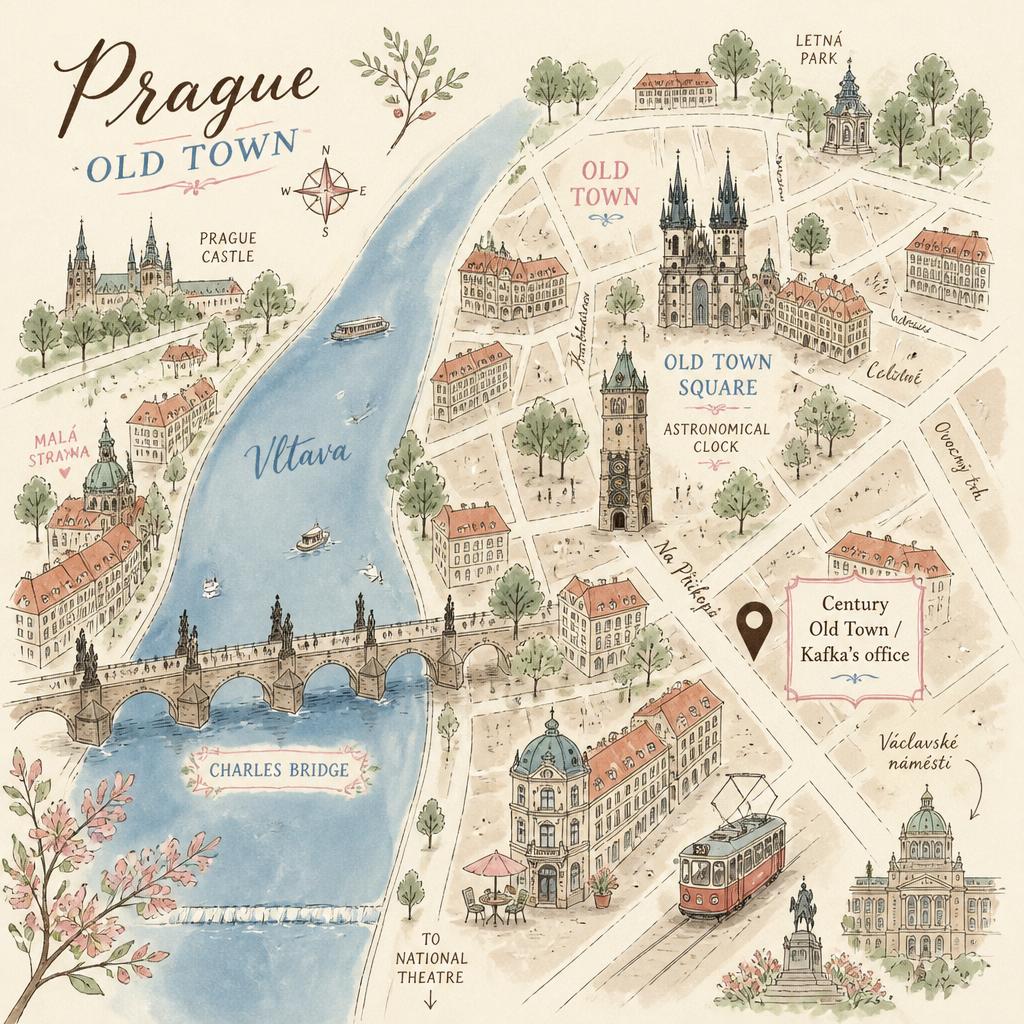
In Prague, a city that seems built for unfinished stories, the Century Old Town Prague MGallery offers exactly that: a neo-baroque building from the early 1900s, restored with care, standing quietly on Na Poříčí street just beyond the frenzy of Old Town Square.
The lobby greets you with mosaic floors and high ceilings that recall the grand cafés of Kafka's era. Guest rooms are understated — warm woods, curved headboards, tall windows that open onto red rooftops or inner courtyards. Nothing shouts; everything invites lingering. Directly next door is the Café Imperial, its ceramic panels and columns unchanged since 1914, a space Kafka himself occasionally entered.
Kafka spent his days in these streets, working at an insurance office not far away, meeting friends in cafés that doubled as offices and confessionals. His favourite was the Café Arco (demolished long ago), the heart of the German-speaking literary circle. He frequented the Café Louvre on Národní Avenue until around 1905, with its marble tables and philosophical debates. The Café Slavia, across from the National Theatre, was another haunt, though he preferred quieter corners.
From the hotel, his Prague unfolds effortlessly. Walk five minutes to the plaque marking his birthplace beside the Church of St Nicholas. Continue to the Old Jewish Cemetery in Josefov, its tombstones piled in uneven layers like forgotten manuscripts. Cross the Charles Bridge — ten minutes more — and arrive at the Franz Kafka Museum in Malá Strana, where letters and first editions sit under dim light. Nearby, David Černý's sculpture of Kafka's head turns slowly in a courtyard, metallic faces shifting like unreliable narrators.
In the late afternoon, when the winter light turns the Vltava the colour of weak tea, return to the hotel. The streets fill with tourists photographing the astronomical clock, but inside it is calm. Take the elevator to a higher floor, pull an armchair to the window, and watch the city settle. The spires remain exactly as Kafka saw them; the trams rattle the same routes. Open a slim volume — perhaps The Metamorphosis — and read at the pace the city demands: slowly, attentively. Gregor Samsa wakes to find himself transformed, trapped in his room, while outside the familiar world continues unchanged. Here, looking down at Prague's unchanging rooftops, the parallel feels almost too neat, yet entirely earned.
Things to know — Location: Na Poříčí 7, Old Town; 5-minute walk to Old Town Square, 15 minutes to Charles Bridge. Style: restored neo-baroque with preserved Art Nouveau details and contemporary comforts. Rooms: 169 rooms and suites, many with city or courtyard views. Amenities: free Wi-Fi, small fitness room, direct access to Café Imperial. Breakfast: generous buffet in the historic café space. Accessibility: elevators throughout; specify needs at booking. Nearest Kafka sites: birthplace plaque (400 m), Old Jewish Cemetery (800 m), Franz Kafka Museum (1.5 km).
Recommended editions: The Metamorphosis (Vintage Classics), The Trial, Letters to Felice.
Some cities overwhelm; Prague absorbs. In this particular room, with its quiet light and century-old bones, Kafka's presence feels less like a ghost and more like a considerate roommate — one who understands the value of silence.