The border between England and Wales runs, more or less, straight through the middle of this town, though nothing on the ground marks it — no gate, no sign, just a river and a slow change in the shape of the hills. This is a walk, in the order you'd actually make it, starting where the road drops you and ending at the water.
Start at Lion Street. Richard Booth's Bookshop anchors the town both physically and historically — three floors, floor-to-ceiling shelves, its own small cinema a few doors down on Brook Street. This is where the whole story began: in 1962, a young local named Richard Booth opened a secondhand bookshop in the town's old fire station against everyone's advice, then spent two decades buying up the cinema, the chapel and the workhouse, filling all of them with books bought in bulk from closing libraries and estate sales across Britain and America. On April Fool's Day in 1977, he rode down this same street on a horse, wearing a homemade cardboard crown, and declared Hay an independent kingdom — crowning himself King Richard Coeur de Livre, Richard the Bookheart, appointing his horse Prime Minister, issuing passports stamped in the town's two pubs, sending a small rowing boat out on the Wye as a self-styled coast guard. It was a joke that worked: the publicity brought booksellers, then readers, then the rest of the world. By the time Booth died in 2019, this small town had roughly twenty surviving bookshops for a population of about 1,500 — a ratio that makes almost no economic sense and exists anyway.
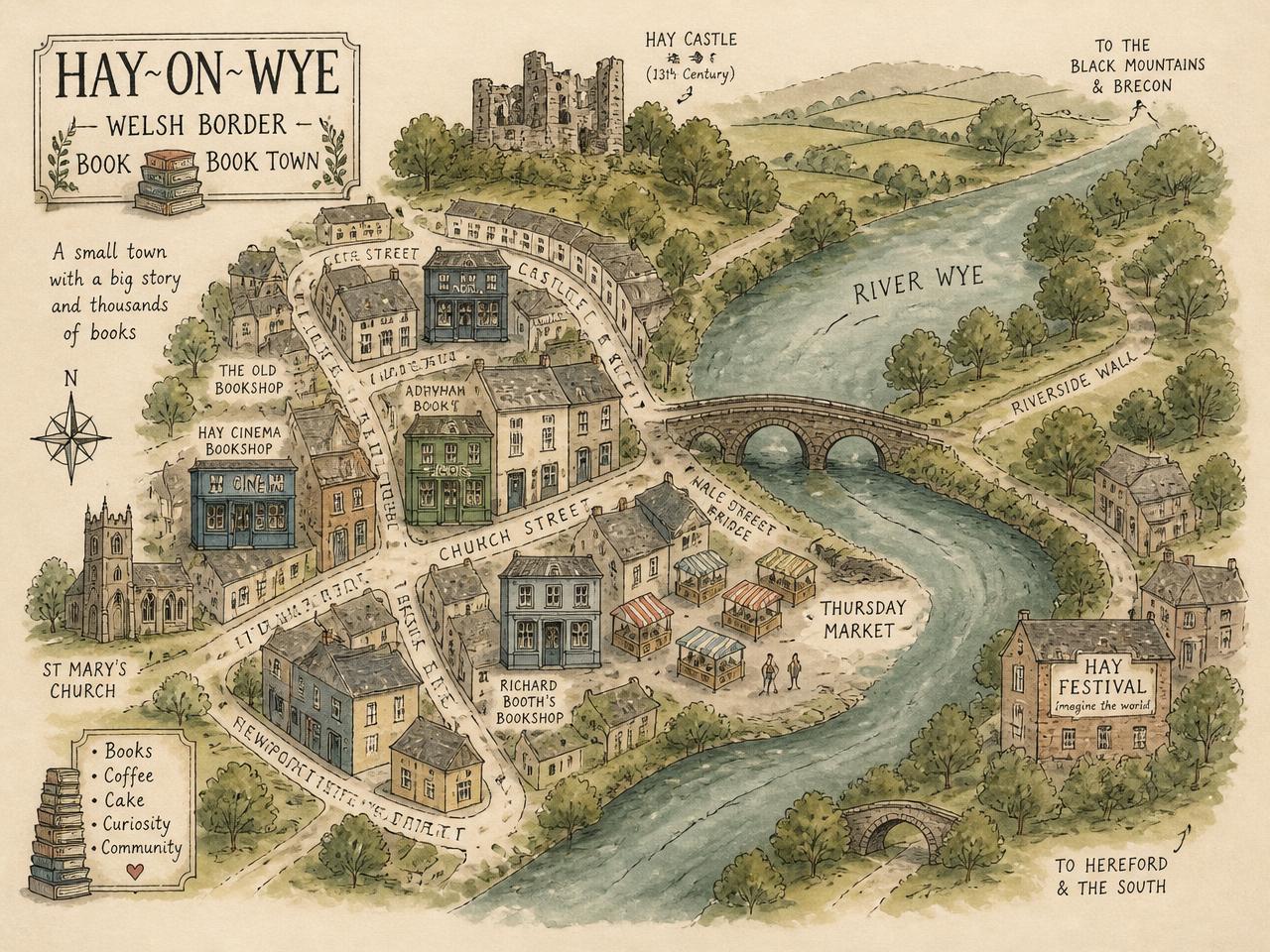
Turn onto Castle Street, toward the ruins. Hay Castle dates back to roughly 1070, rebuilt and rebuffed across nine centuries, and now holds a café that's open daily. Just outside the castle walls sits Hay's honesty bookshop — open shelving, no staff, a payment box, everything £1. It's either the most trusting retail model left in Britain or the last one still willing to bet on it.
Cut down Broad Street. This is where the specificity of Hay really shows itself: Murder and Mayhem deals only in crime, the Poetry Bookshop only in poetry, the Children's Bookshop only in children's titles — each one a short walk from the last. Break here for tea at the Globe, a converted chapel turned arts space that serves loose-leaf tea in a room that's usually mid-lecture, mid-concert, or mid-something else entirely; check what's on before you sit down, because you may end up staying far longer than a cup of tea requires. The café itself is unmissable before you're even inside it — teal paint, an orange sign, floor-to-ceiling windows throwing warm light onto exposed brick.
Down to Thursday market, if your timing allows. Hay's market has run in the town centre for over 700 years, which makes it older than most of the books being sold a few doors away. For a proper sit-down meal nearby: Chapters holds a Michelin Green Star for sustainability, much of its menu grown or foraged by the couple who run it, served under parquet floors and leaded windows that make the room feel slightly out of time. The Old Black Lion, a 17th-century coaching inn a few streets over, runs live jazz on Friday nights alongside a proper seasonal menu.
Follow the path out toward the river and the Warren. A series of sculptures lines the walking route along the Wye, easy to miss if you're moving quickly, which by this point in the walk you generally aren't. The Bean Box sits directly on the riverbank — takeaway coffee, meant for exactly this stretch of path rather than for lingering. The Lion Street Gallery and Bluestone Gallery, back toward the centre, both show local and regional work, low-key enough that browsing feels closer to visiting a friend's studio than a formal viewing.
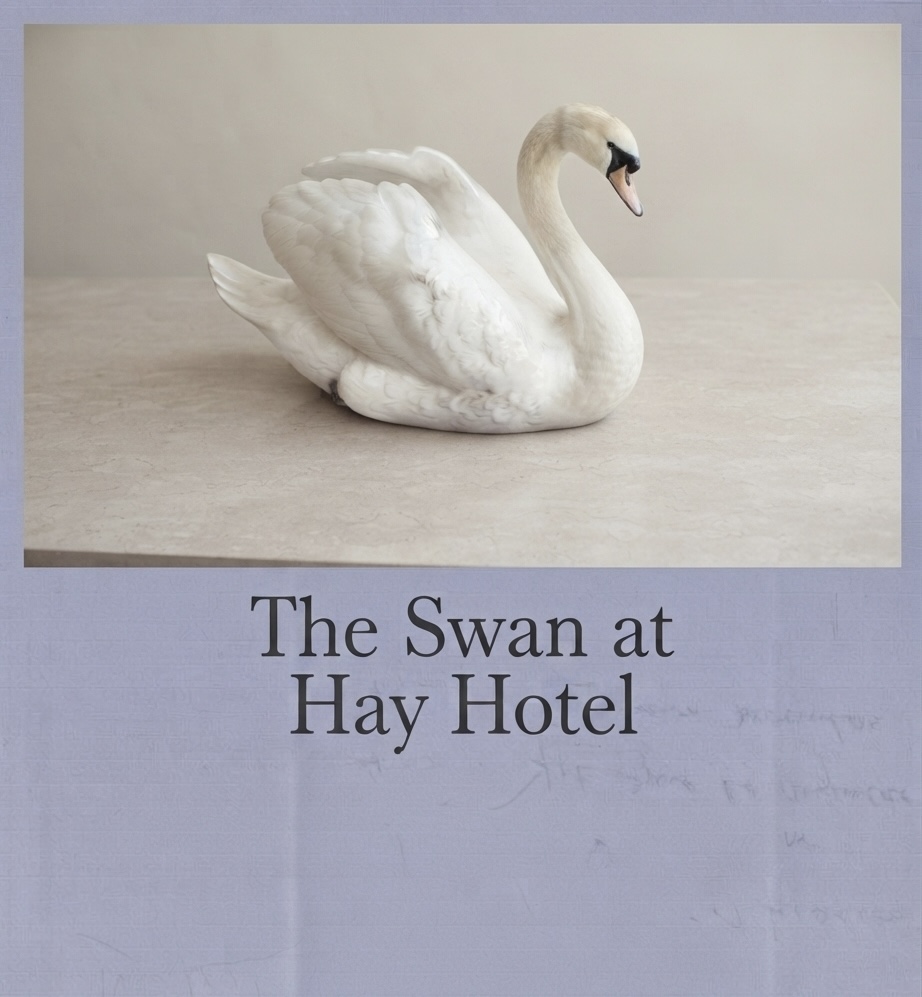
To stay: The Swan at Hay, a refurbished Georgian building in the town centre, keeps you within this entire walk on foot. For something quieter at the end of the day, Llangoed Hall sits a short drive out — seventeen acres of landscaped grounds standing in deliberate contrast to the town's cram of shelves and cobblestone.
What to read on the way, or after: the pairing isn't set in the town itself but a few miles from it — Bruce Chatwin's On the Black Hill, a 1982 novel following twin brothers who spend their entire lives on a single hill farm in these exact hills, on this exact border. Reading it with the actual Black Mountains visible out the window turns a novel about staying put into something closer to a document.
The colour of the walk, if you're sketching it: slate roofs going silver-grey in rain, sandstone the colour of strong tea, and the deep, unglamorous green of the Wye itself, moving past all of it steadily enough that you stop noticing it's moving at all. Bring a pencil rather than a paintbrush — the town rewards attention to line and edge, a shelf, a doorframe, a stack of spines, more than it rewards colour, which mostly announces itself anyway.
It's a strange thing, walking a town where the primary export is other people's old thinking. Somewhere between the fifth and sixth bookshop, you stop browsing for anything specific and start letting the shelves suggest what you didn't know you wanted — which, in the end, might be the entire, quietly radical point of what Richard Booth built here: a kingdom with no industry of its own, running entirely on the accumulated, secondhand attention of everyone who ever finished a book and let it go.
Next chapters: Edinburgh — literary capital: independent bookshops in the New Town and Stockbridge, Sunday farmers' markets, art in Dean Village and the Old Town's small galleries. Portugal (Comporta/Alentejo) — pine forests and rice paddies meet design-led guesthouses, slow seafood markets, ceramic studios, and a quiet, art-collector crowd.