Four historic English estates are running major contemporary art exhibitions at once this summer — a genuine, unplanned convergence rather than a coordinated season, but taken together it amounts to one of the more interesting stretches on the UK art calendar in years. All four are open now.
Houghton Hall, Norfolk — Lynn Chadwick, through October 4. The largest UK exhibition of Lynn Chadwick's work in more than two decades, curated by Pangolin London: over 30 sculptures spanning four decades, from the 1950s through the 1990s, installed across the Neo-Palladian house and its parkland. Chadwick, who died in 2003, remains the youngest sculptor ever to win the International Prize for Sculpture at the Venice Biennale — he took it in 1956, beating Alberto Giacometti. The show includes his best-known couples — paired, angular figures in dialogue with each other — alongside kinetic works and a group of his sharp-edged animal beasts. Houghton has spent over a decade building a reputation as one of Britain's serious contemporary sculpture destinations, having previously hosted Richard Long, Damien Hirst, Anish Kapoor and Antony Gormley.
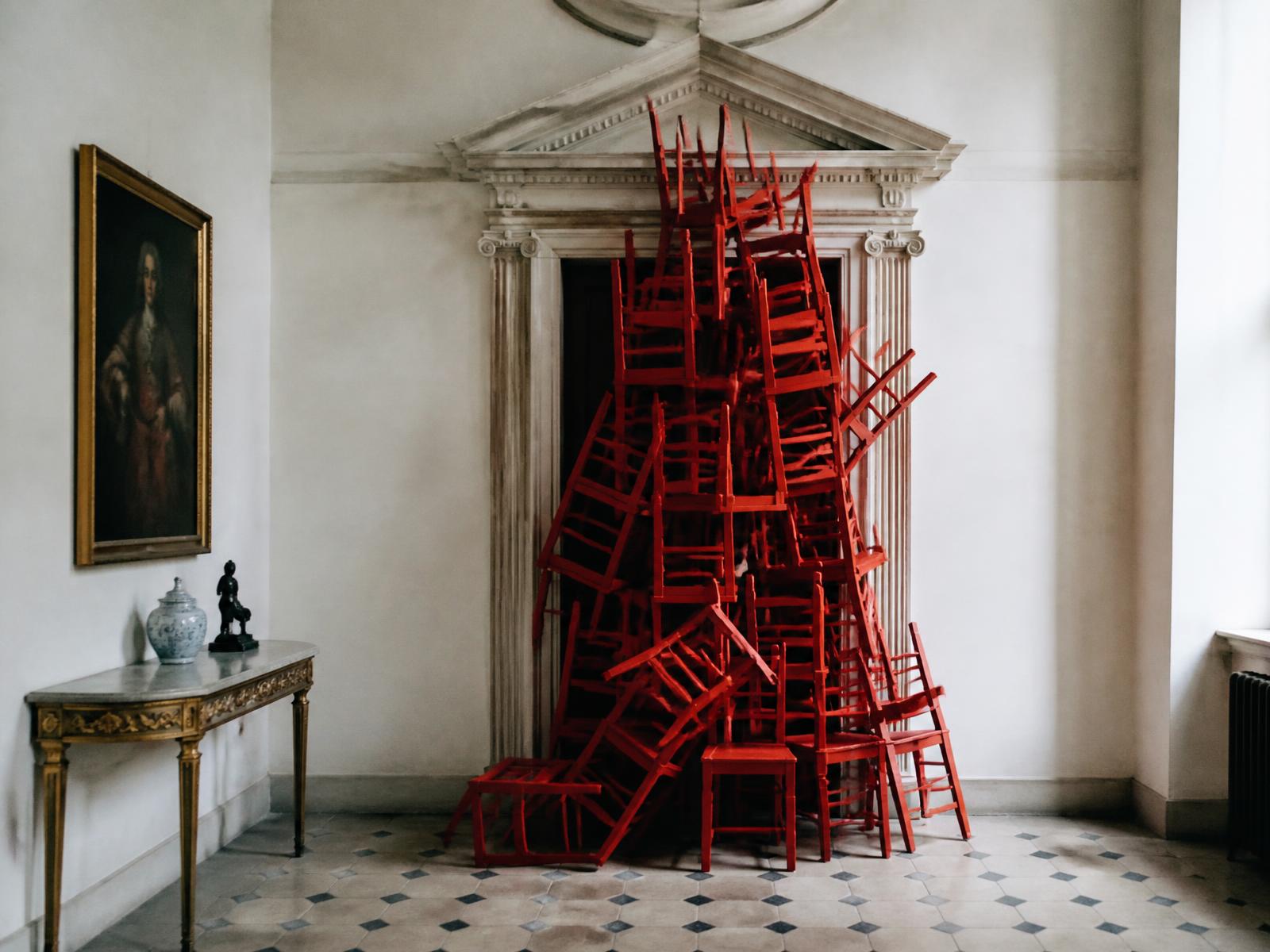
Wolterton Hall, Norfolk — Phyllida Barlow & Daisy Parris, through October 31. Wolterton, a Palladian house built in 1741 for Horatio Walpole (brother of Britain's first Prime Minister, Robert Walpole, whose own estate is Houghton, a few miles away), is only in its second year of running an art programme — and already showing real ambition. Phyllida Barlow: disruptor brings together more than 70 works from across five decades, including a deliberately precarious, half-toppling stack of red chairs blocking a hallway doorway. Running alongside it, Daisy Parris presents Fist Full of Dreams, anchored by a five-metre hand-stitched textile installation called Kiss the Storm — initially hand-knotted at a specialist studio in India, then reworked by Parris herself, a nod to a family history of women who sewed and knitted. The pairing sets Barlow's raw, structural instinct against Parris's more intimate, textile-based one, in the same rooms.
Goodwood Art Foundation, West Sussex — Nancy Holt, Yayoi Kusama, Eva Rothschild and others, through November 1. Now in its second summer season, Goodwood Art Foundation's 70-acre landscape (built into a former chalk quarry) is anchored by the first major UK exhibition dedicated to the American land artist Nancy Holt, titled MoonSunStarEarthSkyWater. Holt, best known internationally for her Sun Tunnels installation in the Utah desert, is shown here through early concrete poetry, photography, film, and Hydra's Head — a set of water-filled pools built directly into the quarry, arranged to mirror the Hydra constellation. Elsewhere across the grounds: an outdoor sculpture by Yayoi Kusama, newly commissioned tapestries by Eva Rothschild woven locally at West Dean's Tapestry Studio, and what's billed as the first outdoor sculpture by Brazilian artist Hélio Oiticica ever realised in Europe. Under-18s visit free year-round.
Claydon House, Buckinghamshire — White Cube at Claydon, through September 14. The most sprawling of the four: a collaboration between the gallery White Cube, the National Trust and the Verney family (who still live at Claydon), bringing more than 20 international artists into an 18th-century house with its own tangled family history — Florence Nightingale's sister married into the Verney line, and her old bedroom is among the rooms used for the show. Antony Gormley, Tracey Emin and Anselm Kiefer have sculptures installed across the lawns and glasshouses; Mona Hatoum, Jeff Wall and Cai Guo-Qiang are among the artists shown inside, in rooms including the ornate, Chinese-Room-style interiors the house is known for. Two normally private gardens — the walled Pool Garden and the Florence Nightingale Garden — have been opened to the public for the exhibition's run, for the first time.
Why now, and why all at once: none of the four institutions coordinated this — it's closer to a genuine shift in how English country estates see themselves, several arriving at the same conclusion in the same year: that a historic house with acreage and empty rooms is, increasingly, understood as underused gallery space. Houghton pioneered the model over a decade ago; Wolterton and Goodwood are recent, deliberate follow-ons; Claydon is the National Trust's own first attempt at the same idea, at real scale.
For the sketchbook: Wolterton's stacked red chairs, Goodwood's water-filled Hydra's Head pools set into raw chalk, and Claydon's Florence Nightingale Garden — opened to the public for the first time in the house's history — are the three most visually distinct, least Instagrammed-to-death images across all four shows.