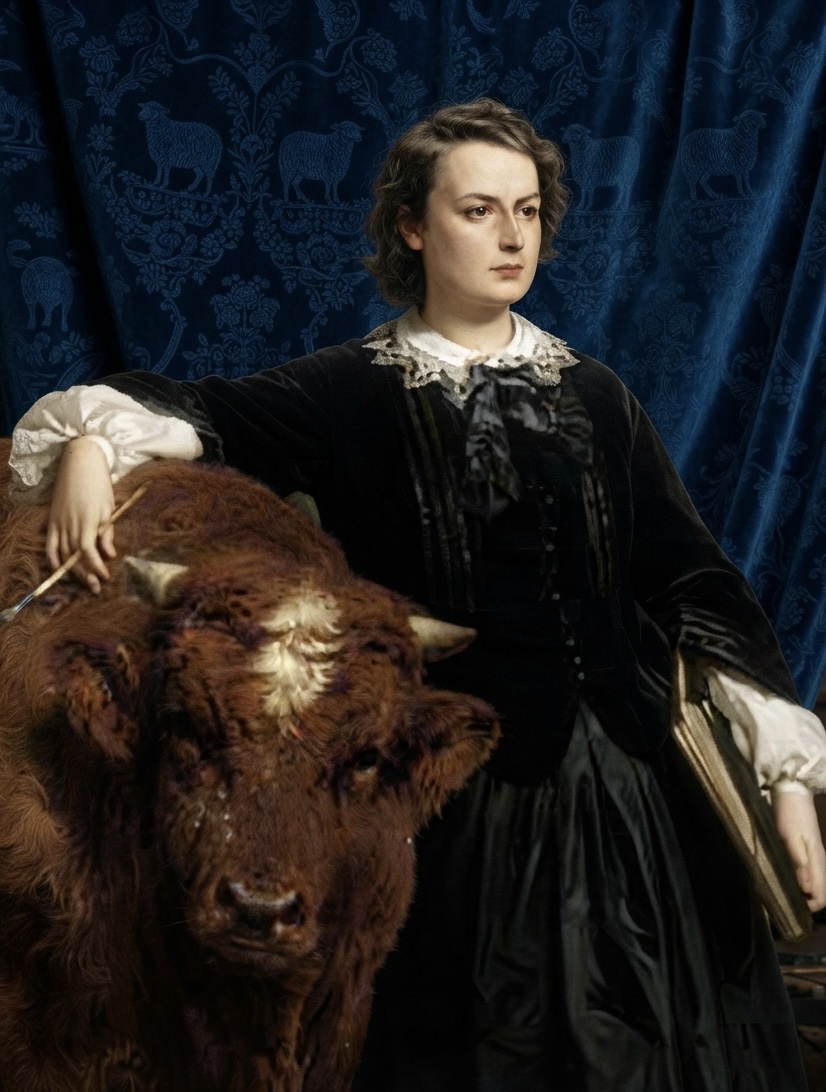
Rosa Bonheur was born in Bordeaux in 1822 and died at Château de By, near Fontainebleau, in 1899. Between those dates she became the most commercially successful woman artist of the nineteenth century — a painter of animals at a moment when the French academic hierarchy ranked animals close to the bottom of what was worth painting at all, and who succeeded anyway, mostly by refusing to paint them from the imagination.
Her father, Raymond Bonheur, was a drawing master and a follower of Saint-Simonianism, a utopian movement that held, unusually for 1830s France, that women were the intellectual equals of men. She was taught to draw at home after being removed from school, and she learned anatomy the way a veterinarian would: from carcasses at the abattoirs of Paris, from the horse market on the Boulevard de l'Hôpital, from live animals kept in the family apartment. Copies after the Old Masters at the Louvre did the rest.
The trousers came out of that method rather than out of ideology. Sketching for hours in slaughterhouses and livestock markets in the crinolines of the period was, practically, not possible — and a woman alone in those places attracted a crowd. From 1852 the Paris Prefecture of Police issued her a permission de travestissement, a cross-dressing permit renewable every six months, which allowed her to wear men's clothing in public for reasons of work. She kept renewing it for decades. She was clear that she wore trousers to be left alone, not to be looked at.
The Horse Fair, finished in 1855 and roughly eight by sixteen feet, is the painting that made her internationally famous. It toured Britain and America as a paid attraction, was engraved and reproduced endlessly, and was eventually bought by Cornelius Vanderbilt II, who gave it to the Metropolitan Museum of Art in New York, where it still hangs. Ploughing in the Nivernais (1849) had already secured her reputation in France; Queen Victoria requested a private viewing of the Horse Fair at Buckingham Palace.
At By she kept a menagerie that functioned as a studio: horses, sheep, deer, monkeys, an otter, and — most famously — lions, including a lioness named Fathma who lived loose in the grounds and was painted from a few feet away. She was the first woman artist to be awarded the Grand Croix of the Légion d'honneur, in 1894, and she lived openly for more than forty years with Nathalie Micas, and after Micas's death with the American painter Anna Klumpke, who became her heir and biographer.
The permit is the detail everyone remembers, and it is worth remembering precisely: not a rebellion, a form. A piece of municipal paperwork that had to be renewed twice a year so that a painter could stand in a field and look at a bull for as long as the light lasted.