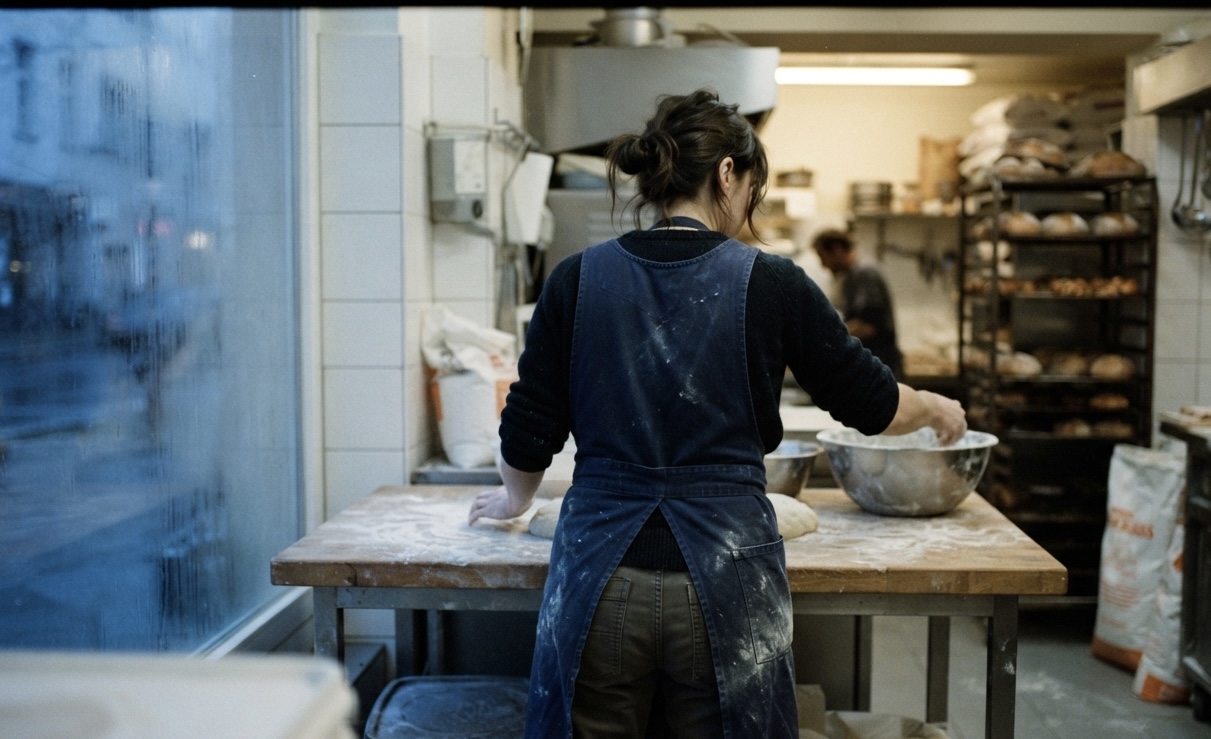
At 3:40 in the morning, Ingrid Button unlocks a bakery that won't open to customers for another three hours, switches on exactly one light — the one above the ovens, never the front room — and begins, in total silence, to make four hundred croissants that other people will eat with their eyes barely open, thinking about nothing at all.
She has done this for nineteen years. Not this bakery the whole time — three bakeries, two cities, one brief and unhappy stint managing a hotel kitchen that kept "normal" hours, which she left after four months because, in her words, "the day felt like it had too many people in it."
The lamination happens first, always, because butter behaves better in cold, dark rooms than it does once the sun and the ovens have both started working on the air. She folds the dough in thirds, turns it a quarter turn, rolls it out, folds again — a process she repeats six times over two hours, alone, while outside the window a city she's lived in for a decade slowly stops being empty. She doesn't own a radio in the kitchen. She used to. She took it out after a year.
"You start listening for the wrong things," she said, when I asked why. "The dough tells you when it's ready by sound, a little. You can't hear that under music."
There's a version of this job that sounds lonely from the outside, and Ingrid doesn't entirely disagree, though she resists the word. What she describes instead is a kind of privacy most people never get inside their own work — three, four hours where no one needs anything from her, where the only feedback loop is butter and flour and temperature, entirely indifferent to her mood, incapable of disappointing her or being disappointed by her.
By 6:15, the ovens are full, the front room light goes on, and the version of the bakery that customers know — warm, lit, smelling exactly the way a bakery is supposed to smell — exists for the first time that day. Ingrid takes this moment, most mornings, to step outside for four or five minutes, no coat, into whatever the weather is doing, and eat the first croissant of the batch standing on the sidewalk before anyone else gets one.
"It's the only one I really taste," she said. "By the time customers are eating them, I'm already thinking about tomorrow's dough."
She's home most days by nine, asleep by ten, awake again at two the following morning, and has arranged her entire adult life — friendships, a decade-long relationship that ended partly over this, a general sense of what "weekend" even means — around a schedule that puts her most alert, most capable hours into a stretch of time when almost no one she knows is conscious to witness them.
I asked if she minded that no customer would ever see her working, that the entire skilled, exacting middle of her day happens in a locked room before the city has any reason to think about her at all.
She considered this longer than she'd considered anything else I'd asked. "I used to," she said finally. "Now I think the version of me at 4 a.m. is more honestly me than the one who hands you the croissant. That one's just being polite."