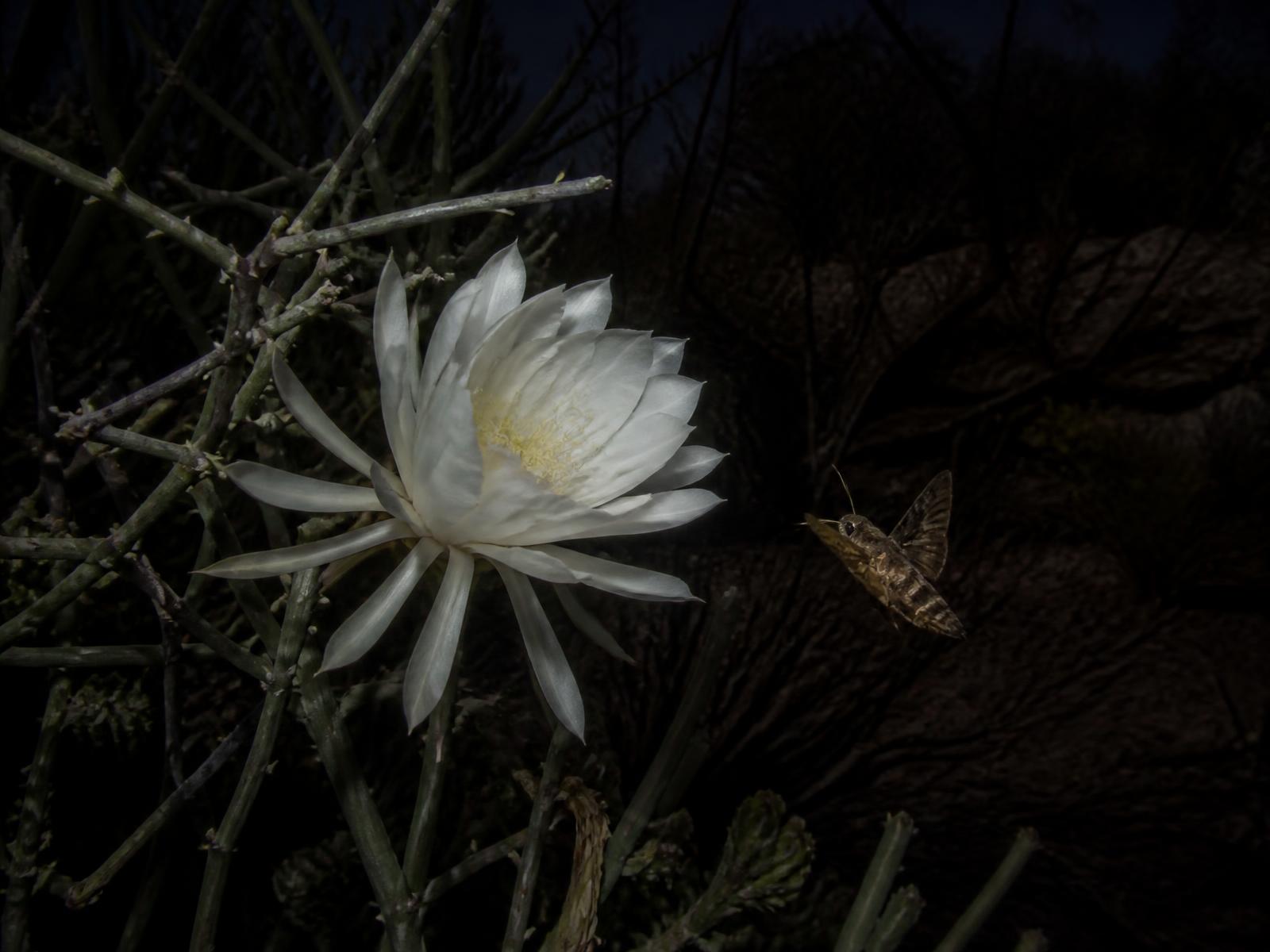
For most of the year, the Night-Blooming Cereus doesn't look like anything worth watching. Its Latin name is Peniocereus greggii, but in the Sonoran Desert it goes by a better one: Reina de la Noche, Queen of the Night. Scattered through the scrub of southern Arizona and northern Mexico, its thin, grey-green stems tangle low to the ground, easy to mistake for dead brush or a dried-out weed — which is more or less the point. It spends nearly its entire life disguised as nothing.
Then, on one night a year, it isn't. Triggered by the early heat of summer, the plant produces large white flowers that open after sunset, reach full bloom around midnight, and wilt completely by the time the sun returns. The flowers are fragrant, pale enough to catch and hold moonlight, and gone by morning — a single overnight performance from a plant that spends the other 364 nights looking deliberately unremarkable.
The timing isn't sentimental, it's mechanical. The flowers can't self-pollinate, so an individual plant blooming alone accomplishes nothing — it needs to open on the exact same night as every other Queen of the Night in the area, in order for its one pollinator, the hawk moth, to move between them before dawn. Scientists studying the plant believe there's some form of chemical signalling between individuals that synchronises the bloom across an entire population, though the full mechanism isn't settled. What is clear: heat, moisture and daylight all factor into the trigger, and the flowering is timed to let seeds mature and disperse before the desert's summer monsoon ends.
Because the bloom is single-night and largely unpredictable, entire communities have built traditions around watching for it. In Tucson, Tohono Chul Park holds an annual Bloom Night — caretakers monitor the park's cactus population daily through early summer, and typically can't confirm a bloom is actually happening until midday of the same day, at which point word goes out and visitors arrive that evening to watch several hundred plants open in near-unison. It's one of relatively few public events built entirely around a flower's schedule rather than a calendar date.
A related, unrelated plant carries the same nickname and the same one-night habit: Epiphyllum oxypetalum, also called Queen of the Night in parts of Asia, native originally to Mexico but carried to China as early as the 1600s, where it became known as the Tan Hua — considered a symbol of luck, its rare bloom treated as an auspicious event worth staying up for. It was the flower at the centre of a pivotal scene in the 2018 film Crazy Rich Asians. Unlike its desert namesake, it can take up to seven years to produce its first flower at all, and afterwards grows a small, edible fruit, not unlike a miniature dragon fruit.
Both plants make the same argument in different deserts and different cultures: that a single night of visibility, correctly timed, can be worth years of looking like nothing at all.