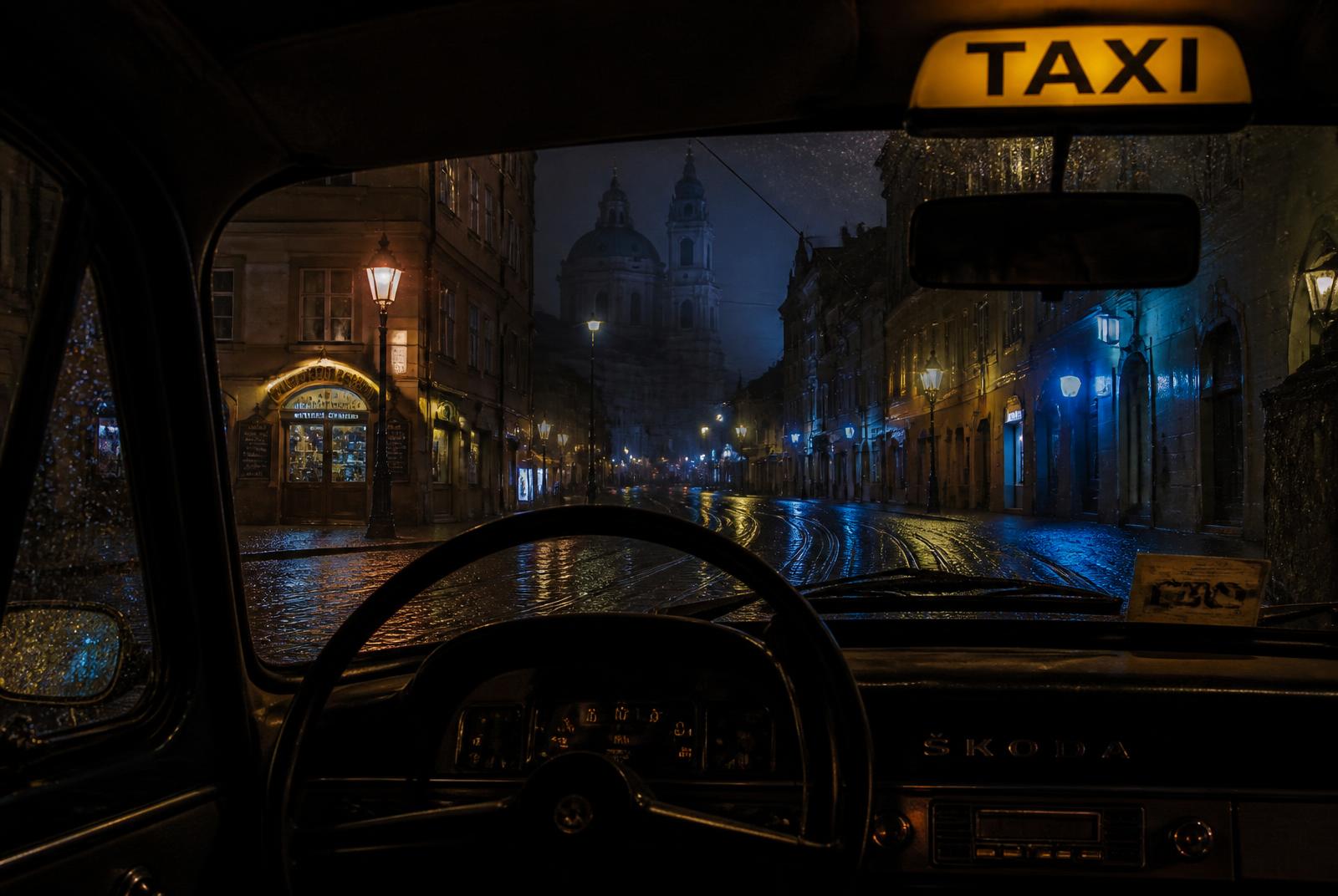
The rank outside Hlavní nádraží holds nine cars at 1:40 in the morning and Pavel Zeman is seventh. He has the window down two fingers in November because the heater in a 2011 Octavia either roasts you or does nothing, and because the man in front of him smokes. Rain has been falling since Tuesday. The tram tracks on Bolzanova hold it in two bright seams.
The lamp on his roof says TAXI in the yellow the city requires. So does the door: company name, licence number, the price per kilometre in figures large enough to read from the kerb, because Prague spent two decades being a punchline about taxi fares and now writes the arithmetic on the paintwork. Pavel keeps a receipt printer bolted under the dash. He offers the receipt before anyone asks. He has watched people be surprised by this roughly four thousand times.
A hen party comes out of the station doors in matching sashes and takes the second car. Two Slovak boys with a guitar case take the fourth. The queue closes up. Pavel moves forward eight metres, puts it back in neutral, and eats half of a rohlík from a paper bag on the passenger seat.
At 2:05 he takes a woman in a hotel uniform to Prosek. She has a name badge that says MARTA and a phone she does not look at. They pass under the Nusle bridge, which locals do not call the Nusle bridge, and neither of them says anything about it. She asks him to stop at the večerka on Vysočanská, the one behind the roller door, and comes back with two bananas and a coffee in a paper cup. He waits with the meter running because that is the rule and she knows it is the rule and neither of them mentions the four crowns it costs her.
Empty on the way back. This is the part of the job nobody rides along for: forty per cent of the night is driving a silver car with nobody in it through streets designed for horses. He takes Sokolovská because the lights are kinder. At Palmovka a tram passes going the other way with one passenger in it, sitting in the middle of the middle carriage, and the whole thing is lit like an operating theatre.
The night trams run every half hour and all of them meet at Lazarská at the same minute so people can change. At 2:34 Pavel is stopped at the lights beside that interchange, and for ninety seconds there are four hundred people on one pavement — off shift, out late, on their way in — and then there are none, and the timetable has moved them all somewhere else. He turns the radio down and does not turn it back up.
3:10. A hotel doorman on Národní waves him in for a couple who have been arguing in the lobby in English. They argue in the car for eleven minutes, in the way that requires both people to be very polite to the driver. The man tips too much. Pavel says děkuji and means it and hands over the receipt.
3:40 to 4:15 is the hour nothing happens. He parks with two wheels on the kerb at the top of Petřín-facing Úvoz and eats the other half of the rohlík. On the seat beside him: the paper bag, a wet umbrella, a laminated card from the city, a Nokia he keeps for his mother because she cannot hear him on the other phone. He does not check the app. The app checks him.
The mist comes off the Vltava in sheets between four and five. He knows the two streets where it arrives first. He knows which cobbles at the bottom of Nerudova send the steering wheel loose for a metre and a half, and takes them at nine kilometres an hour like a man carrying something full. Eleven years is not knowledge of a city. It is a set of small physical accommodations to it.
At 4:31 the trams stop and the metro has not started. For fifty-nine minutes the only way across Prague that is not walking is a car with a yellow lamp on it. This is when Pavel earns. A chef from Karlín with burn scars on both forearms. A woman with a cello. A student who falls asleep before Vinohrady and has to be woken by name, twice, in a voice Pavel keeps for exactly this. Nobody speaks. Everybody smells faintly of the room they have just left.
5:29, Anděl. The first metro of the day goes past underneath him, felt in the pedals rather than heard, and above ground three people are already standing at a tram stop with their backs to each other. The city has restarted without ceremony. Pavel drives one more fare — Smíchov to Zličín, airport-adjacent, a man with a hard suitcase who says almost nothing — and then puts the lamp off.
He is home at 6:20. His wife is up. The kitchen radio is on. He sleeps until one in the afternoon in a flat where all the blinds close properly, which was the single condition he had when they moved, and which she has never once described to anyone as a strange thing to insist on.