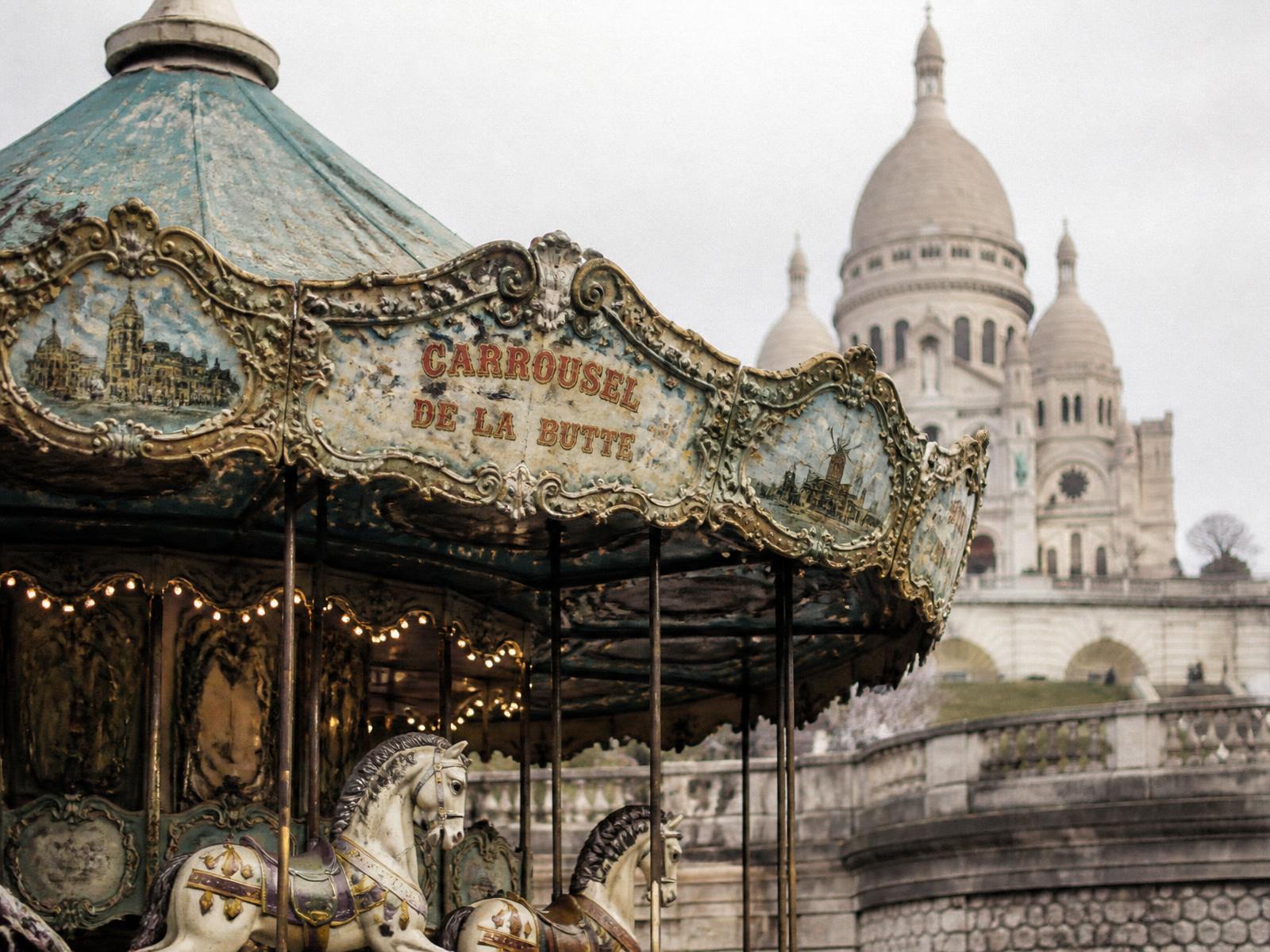
At the bottom of the steps up to Sacré-Cœur, before the climb really starts, sits a carousel with a canopy the colour of shallow seawater — a teal-turned-verdigris blue-green, faded unevenly by a century of weather, with gold trim worn soft at the edges. The horses underneath are secondary. It's the roof people photograph.
The Carrousel de Saint-Pierre sits in Square Louise-Michel, a park that was, before it was a park, a working gypsum quarry — the same soft, unstable ground that later had to be specially engineered to hold the weight of the basilica above it. Sources disagree on exactly how old the carousel is: most place it at 1879, a handful of visitor accounts suggest the 1920s instead. No single authoritative record settles it cleanly, which is, in its own way, appropriate for a ride that's spent well over a hundred years being background scenery to something more famous towering behind it.
The canopy's blue-green isn't paint chosen to match anything — carousel roofs of this era were typically canvas or tin, finished in whatever combination of teal, gold and deep red read as festive to a 19th-century eye, the same palette used across fairground architecture of the period more broadly. What's happened since is weather, not design: a century of Paris rain and UV have pulled the original tone toward something closer to verdigris — the specific blue-green that copper and aged teal both drift toward once oxidation and fading take over from whatever the paint can was actually mixed to.
The horses are carved wood, painted in the ornate, slightly gaudy style typical of French carousels from the period — no two identical, each saddle and bridle individually detailed. Riders have included, at conservative estimate, several hundred thousand children across five or six generations, most of whom never once looked up at the roof they were spinning under.
It's still running. You can still ride it, for a few euros, while a much larger and much whiter building keeps watching from the top of the hill.