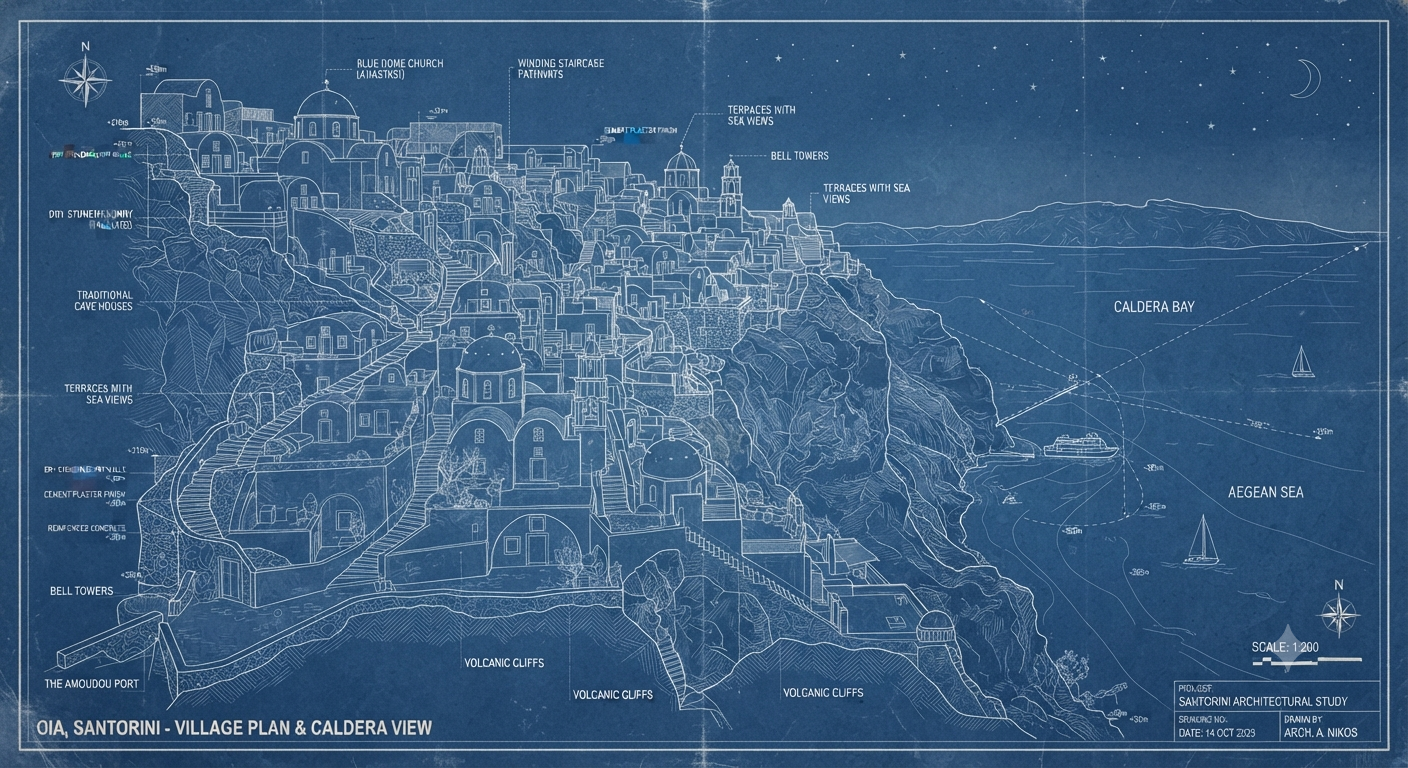
The light does something specific here, just before the sun drops behind the caldera — the blue of the domes goes almost black, then for a few minutes matches the sky so precisely that the roofline seems to dissolve into the air above it. Photographers call this the blue hour. Locals mostly just call it evening.
It's easy to assume the colour has always been here — that it rose out of the volcano along with the island itself, some geological inevitability of ash and sea. It hasn't. The blue is younger than most visitors think, and stranger in its origins than the postcards let on.
Start with the white. Long before anyone was choosing paint for symbolism, Santorini's builders were choosing it for survival. The island's houses were carved into volcanic stone and finished with a lime-based whitewash — asvesti — mixed simply from lime, water and sea salt. It reflected the punishing Aegean sun, kept the thick-walled cave homes cool through summers that regularly pushed past 40 degrees Celsius, and had the added, unplanned benefit of functioning as a mild disinfectant, which made it a practical choice during periods when hygiene mattered more than aesthetics. In the early 20th century, Greek public health campaigns reinforced the habit further, pushing whitewash as sanitation as much as style.
The blue arrived by accident, and by economy. Fishermen mixing paint for their boats often had loulaki left over — a cheap blue laundering powder, widely available across Greece, originally used by housewives to whiten linens. Rather than let it go to waste, they brushed the leftover blue onto window frames and shutters, and over generations it worked its way from the boats to the buildings, mixed into limestone plaster wherever there was a surplus and a wall that needed colour. For a long stretch of the island's history, this was closer to habit than doctrine — some domes stayed pale blue, some went nearly white, some took on the ochres and pinks that Venetian-era merchants had once used centuries earlier to mark their wealth apart from the humbler cave dwellings around them.
The uniform blue-and-white you see today — the version that has become shorthand for Greece itself — is younger than the Beatles. In 1967, the military junta that seized power in Greece issued a decree requiring buildings across the islands to be painted white and blue, deliberately echoing the national flag. It was policy dressed as aesthetics: a way to manufacture a unified, exportable image of Greek identity just as international tourism was becoming a serious economic engine. What had been a loose, improvised palette — practical, occasionally decorative, dependent on whatever pigment a fisherman had left over — became law.
The regime that mandated the colour didn't survive the decade. The colour did. It outlasted the junta by decades, was adopted so thoroughly into the island's self-image that Santorini's local architectural committees now protect it, the way another place might protect a historic building. What began as a cost-saving improvisation and hardened into political branding is now simply understood as heritage — protected, replicated, repainted every season to hold its exact shade against sun and salt.
There's a religious layer threaded through all of it, too, older than the junta's decree. In Greek Orthodox tradition, blue carries associations with the divine and the heavens, which is part of why the colour concentrated specifically on church domes rather than spreading evenly across every rooftop. It overlaps, not entirely by coincidence, with an older popular belief that blue wards off the evil eye — the same logic behind the blue glass mati charms sold in every gift shop on the island. Nobody can point to a single moment when the colour became sacred rather than simply available. It seems to have been both, gradually, at the same time.
Stand in Imerovigli at dusk, on the quieter cliffside walk locals call the balcony of the Aegean, and none of this history is visible in any obvious way. What you see is just a dome, a very specific, deep, almost bruised blue, holding the last of the light a few seconds longer than the sky around it does. It looks inevitable. It looks like it could not have been any other colour. That it very nearly wasn't — that it survived by accident, then by law, then by love — doesn't show up in the photograph. It just changes, slightly, what you're looking at.